



News
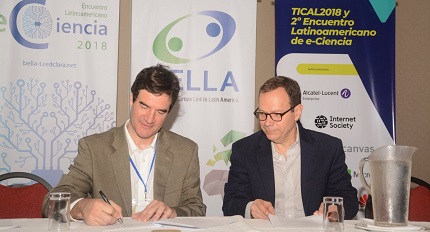
The Latin America Cooperation of Advanced Networks (RedCLARA) and Internet Society (ISOC) signed this Tuesday, September 4, in the framework of the TICAL2018 Conference and the 2nd Latin America Meeting of e-Science, in Cartagena de Indias, a Memorandum of Understanding (MoU) that seeks to enhance collaboration between the two parties. The organizations were represented by Luis Eliécer Cadenas Marín, Executive Director of RedCLARA, and Christian O'Flaherty, Senior Development Manager of ISOC for Latin America and the Caribbean.
Download eVentia, the official application of TICAL2018 and the 2nd Latin American e-Science Meeting
TICAL2018 and the 2nd Latin American e-Science Meeting are now at your fingertips with the the eVentia multiapp. Developed by RedCLARA, the application was launched this Thursday, August 30, and is a platform that will help participants during the events that will gather more than 300 ICT experts in Cartagena de Indias, Colombia, between September 3 and 5.
There is no translation available.
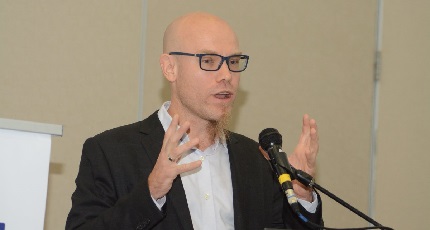
¿Cuáles son las consecuencias y los desafíos resultantes del avance de la Inteligencia Artificial? ¿Cómo se relacionan las RNIE con la IoT? ¿Y cuál es el estado de las TIC en Educación Superior en Latinoamérica? Las respuestas para estas y otras preguntas fueron discutidas en el segundo día de actividades de la Conferencia TICAL2018 y el 2º Encuentro Latinoamericano de e-Ciencia, que se están llevando a cabo desde el 3 hasta el 5 de septiembre, en el Centro Internacional de Convenciones y Exposiciones Las Américas, en Cartagena de Indias, con la participación de más de 350 participantes de América Latina, Europa y Estados Unidos.
The edition number 53 of the DeCLARA bulletin is already online, bringing the news about the 2018 version of the TICAL Conference and the Latin American e-Science Meeting, which will take place next week, from September 3 to 5, at the Las Americana Convention Center, in Cartagena de Indias, Colombia.
There is no translation available.
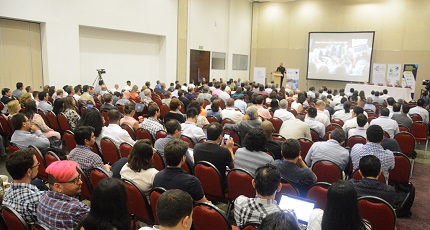
La experiencia de transformación digital de la Universidad Deakin, en Australia, y las discusiones sobre como implementarla en el contexto latinoamericano fueron los temas más destacados en el primer día de actividades de la Conferencia TICAL2018 y el 2º Encuentro Latinoamericano de e-Ciencia. Los eventos empezaron este lunes 3 de septiembre en el Centro Internacional de Convenciones y Exposiciones Las Américas, en Cartagena de Indias, Colombia, con la participación de más de 350 asistentes de distintos países de Latinoamérica, Europa y Estados Unidos.
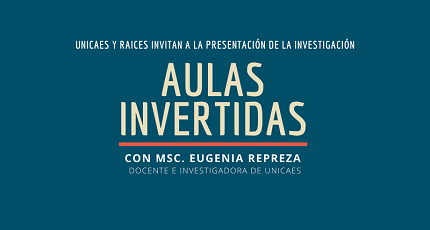
What are the advantages, risks and what improvements represents the"inverted classrooms" educational model, which proposes the change of traditional education to one where the student becomes the manager of its own educational processes? The answer for these and other questions will be announced on Wednesday, September 5, at 4pm (AST), at the presentation "Inverted Classrooms", held within the framework of the Virtual Cycle of Conferences of the Catholic University of El Salvador (Unicaes).