



Cases & Voices
María José López Pourailly
There is no translation available.
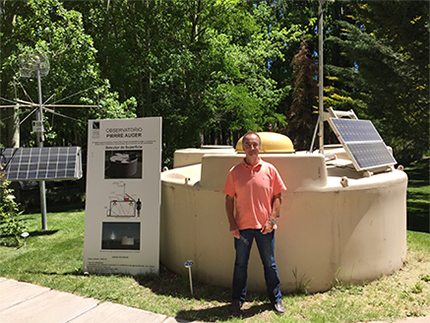
Miembro y representante en España del Observatorio Pierre Auger, y Catedrático del Instituto Gallego de Física de Altas Energías del Departamento de Física de Partículas de la Facultad de Física de la Universidad de Santiago de Compostela, Enrique Zas nos compartió su experiencia en el proceso de observación de la fusión de dos estrellas de neutrones registrado el 17 de agosto recién pasado, la que sindica como una experiencia que cambió la vida de los científicos que en ella participaron.
María José López Pourailly
 August 17, 2017: Scientists from all over the world who study the Universe witness and analyze online and live a historical event that will mark a before and after in the way we understand the study and the development of Astronomy. The news is spread all over the globe on October 17. In our homes and offices, going on the public transport or walking around, we watch on TV, mobile devices and computers the re-creation of a two neutron stars fusion that occurred 130 million years ago in NGC4993, the largest galaxy in the constellation of Hydra. The event was categorized as 'cataclysmic'. The reason for the media and scientific revolution caused by the phenomenon lies in the fact that it was the first of its kind in history to be recorded, seen and listened simultaneously, thanks to telescopes, radio telescopes, gravitational wave detectors and advanced Internet networks - such as RedCLARA and GÉANT, at regional level - that allowed the collaborative work of almost a hundred researchers from all over the world who contributed to the study.

María José López Pourailly
There is no translation available.
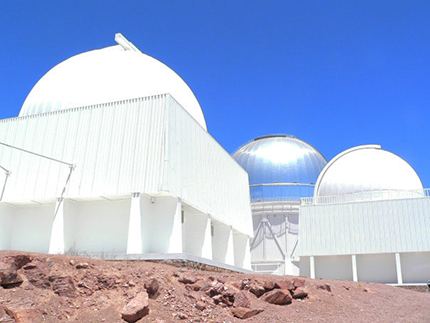
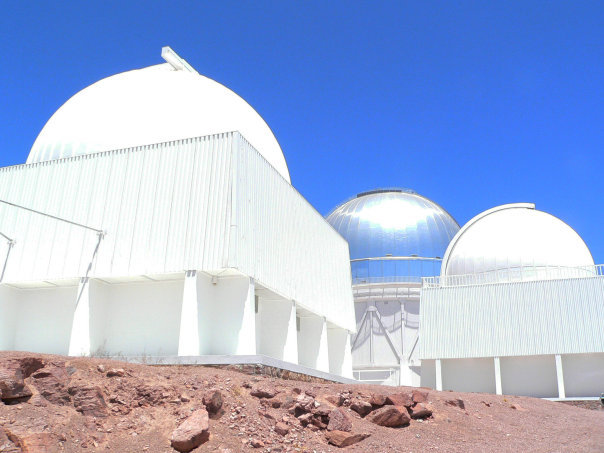
De nacionalidad venezolana, licenciada en Física de la Universidad de Los Andes y doctora en Astrofísica de la Universidad Yale, Kathy Vivas, se desempeña como astrónoma de apoyo en el Observatorio Inter Americano Cerro Tololo, en La Serena, Chile. Desde ahí participó junto al enorme grupo científico que a través de los continentes, gracias a las redes académicas avanzadas, combinaron sus esfuerzos para lograr las primeras observaciones históricas de una kilonova: la fusión de dos estrellas de neutrones ocurrida hace 130 millones de años en la galaxia NGC 4993 de la constelación de Hidra. Conversamos con ella de la importancia de esta colaboración y de cómo se llevó a cabo.
María José López Pourailly
 Borned in Venezuela, graduated in Physics from the University of Los Andes and PhD in Astrophysics from Yale University, Kathy Vivas works as a support astronomer at the Cerro Tololo Inter American Observatory, in La Serena, Chile. And it was from there that Vivas, along with a large team of scientists scattered around the world, participated in the project that resulted in the earliest observations of a ‘kilonova’: the fusion of two neutron stars 130 million years ago in the galaxy NGC4993, constellation of Hydra. We talked with her about the importance of this collaboration and how the work was carried out.
María José López Pourailly
There is no translation available.
17 de agosto, 2017: los científicos del mundo que estudian el Universo presencian y analizan en línea y en vivo un evento histórico que marcará un antes y un después en la forma de comprender el estudio y desarrollo de la Astronomía. La noticia se difunde en todo el mundo el día 17 de octubre, y en nuestras casas y oficinas, en el transporte público o en las calles, vemos en nuestros televisores, dispositivos móviles y computadoras, la recreación de la fusión de dos estrellas de neutrones ocurrida hace 130 millones de años en NGC 4993, la mayor de las galaxias de la constelación de Hidra. Catalogado como cataclísmico, lo alucinante y el por qué de la revolución mediática y científica de este fenómeno astronómico está en el hecho de ser el primero en la historia que se ha podido registrar, ver y escuchar de forma simultánea gracias a los telescopios, radiotelescopios,detectores de ondas gravitatorias y las redes avanzadas de Internet -como RedCLARA y GÉANT, a nivel regional- que permitieron el trabajo colaborativo de casi un centenar de centros astronómicos, laboratorios y universidades, y más de tres mil investigadores, que desde todas las latitudes del mundo contribuyeron en el magno estudio.
María José López Pourailly
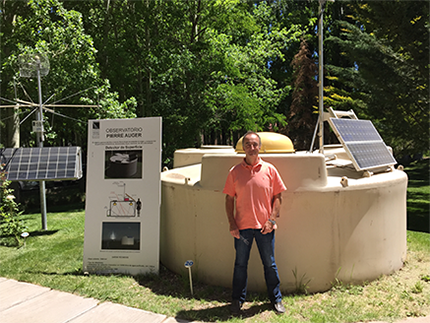
Member and representative of Spain at the Pierre Auger Observatory, and Professor of the Galician Institute of High Energy Physics of the Department of Particle Physics of the Faculty of Physics at the University of Santiago de Compostela, Enrique Zas shared with us his experience in the process of observation of the fusion of two neutron stars recorded on Aug. 17, which he referres as an experience that changed the lives of the participating scientists.