


Honey in the Chain: Blockchain for Beekeeping
Jenny Flores
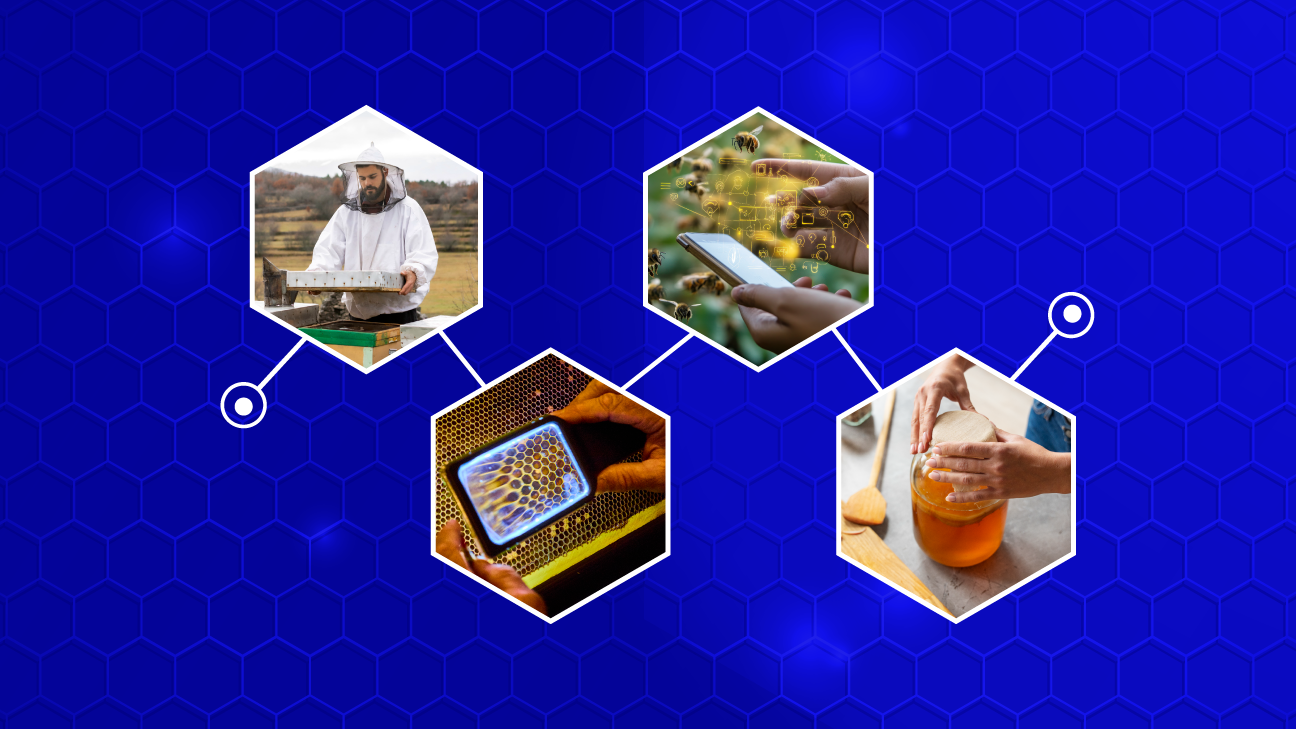 Each jar of honey holds a story we rarely know: that of the families who care for the hives and of the bees that pollinate crops and support ecosystems. Today, thanks to technology, that story can be tracked from the hive to the consumer through secure and accessible records. These records allow production and origin to be verified and are ready to connect to international data networks when needed. This benefit is one of the impacts amplified by the BELLA II blockchain testbed, made available to Latin American initiatives through the Early Adopters LATAM program, driven by RedCLARA and LNET.
In rural beekeeping, there is no simple mechanism for producers to reliably demonstrate that their hives and honey come from sustainable practices and responsible sources. This lack of evidence limits access to sustainable markets, reduces transparency with authorities and buyers, and exposes small producers to fraud and loss of value. Traditional certifications are often slow, costly, and centralized, making them inaccessible to most.
Operating in rural areas of Colombia, Peru, Ecuador, and Bolivia, Colmena DAO, one of the four initiatives that reached the final phase of the Early Adopters Blockchain LATAM program, works to strengthen beekeeping in a sustainable and inclusive way. The project combines digital tools with community participation to track honey production, organize decision-making democratically, and economically empower women and youth in rural communities.
Within the broader Colmena DAO project, this first functional prototype (MVP) is an initial step toward achieving full honey traceability. Thanks to it, each jar can show its story from the hive to the consumer’s table, with secure and accessible records that allow verification of production and origin, ready to connect with international standards when necessary.
The Challenge and First Steps
In 2022, together with beekeepers trained in sustainable apiculture from an institute in Ecuador, the need arose to address one of the sector’s main challenges: honey adulteration. Due to this concern, the development of technological solutions was promoted to certify product origin, ensuring authenticity for consumers and environmental sustainability in the processes. The initiative is part of a broader effort to strengthen traceability, technological innovation, and the professionalization of beekeeping, in coordination with sector stakeholders.
Collaboration among different actors has made Colmena DAO's success possible. Academic institutions from Colombia and Ecuador, among others, supported the technological implementation, while beekeepers actively participated throughout the process.
The initiative was led by Philippe Boland, a regenerative designer with experience in interinstitutional projects in Latin America and coordinator of international networks such as enREDo and Red Colmena, along with José Zárate, a technology intelligence specialist from Peru with over 25 years of experience in the tech sector and co-founder of Stamping.io, a platform that certifies, seals, and digitally verifies documents, data, and transactions using blockchain technology. Joining this effort was Laureano Carlosama, manager of a beekeeping company in Ecuador with extensive experience supplying honey to multinational companies, with whom blockchain-based traceability solutions were developed.
“We saw an opportunity in this specialized tool (the BELLA II blockchain testbed) for traceability in beekeeping, particularly for honey,” explained Boland.
Carlosama highlighted the importance of making beekeepers’ work visible and protecting environmental resources. “Caring for bees and natural resources ensures the quality of honey. If bees disappear, many things important to people also disappear. That’s why traceability is essential: it shows both the product and the beekeeper’s work,” he noted.
Other active participants in this initiative included CONAPI Peru, the UxTIC University Network, and the Ibero-American Cybersecurity Network (RIBCI), among other institutions and organizations, which played a key role in exchanging experiences and strengthening the network’s collective capacities.
According to Boland, the first phase of the project focused on using the BELLA II blockchain technology to securely store information and ensure full production tracking, providing concrete support to beekeepers. Thanks to collaboration with the university, the blockchain platform was introduced to producers, who initially perceived it only as a cryptocurrency tool and did not understand its usefulness for managing, securing, and controlling honey from the hive to the consumer.
In the long term, the initiative aims to create traceable pollination credits, linked to environmental monitoring via smart hives. The Colmena DAO team works with several universities to develop these hives using free and open-source software. In this context, the GNU/Linux Group of the Universidad Distrital (GLUD), an active member of Colmena DAO, took on the challenge of ensuring that all tools used operate exclusively on free technologies. As a first step, the team is developing Colmena, a server system deploying FLOSS software to enable secure communication and collaboration channels among beekeepers, universities, companies, and other project stakeholders.
This shared infrastructure seeks to reduce dependence on proprietary services and strengthen technological sovereignty, allowing each actor to maintain direct control over their data, processes, and tools. “It’s important that a project like this is accessible to someone with a thousand hives as well as to someone with just one. That’s why it must rely on a collaborative model where the ecosystem’s benefit guides decisions,” explained Cristian Guzmán, GLUD group leader.
The project is now moving toward territorial pilots, connected hives, monitoring systems, and income models based on pollination and the local bioeconomy.
For Julian Londoño, services analyst at RedCLARA, the goal of the Early Adopters initiative was achieved: “Blockchain has shown that emerging technology testbed services, deployed through the BELLA II project, can help us tackle real challenges in the region, generate value in Latin America, and impact people’s lives.” As the implementer of the BELLA II project, RedCLARA has achieved tangible success, fully meeting its goal of providing participating teams not only with technological infrastructure but also expert guidance and access to applied knowledge, thus strengthening innovation and collaboration capabilities in the region.
The Early Adopters LATAM call, launched at the end of September 2025, invited proposals for innovative solutions that leveraged this infrastructure to address real regional challenges. The response was remarkable: we received nine proposals from seven countries. After evaluation, four projects advanced to the immersion and development phase, which included technical mentorship, specialized training, and the opportunity to develop and test early operational versions of their solutions in a real environment.

Rambla República de México 6125.
Montevideo 11400. Uruguay.
Montevideo 11400. Uruguay.