


DeCLARA 62: Cooperation, innovation and cybersecurity to strengthen the future of education and science in Latin America and the Caribbean
María José López Pourailly
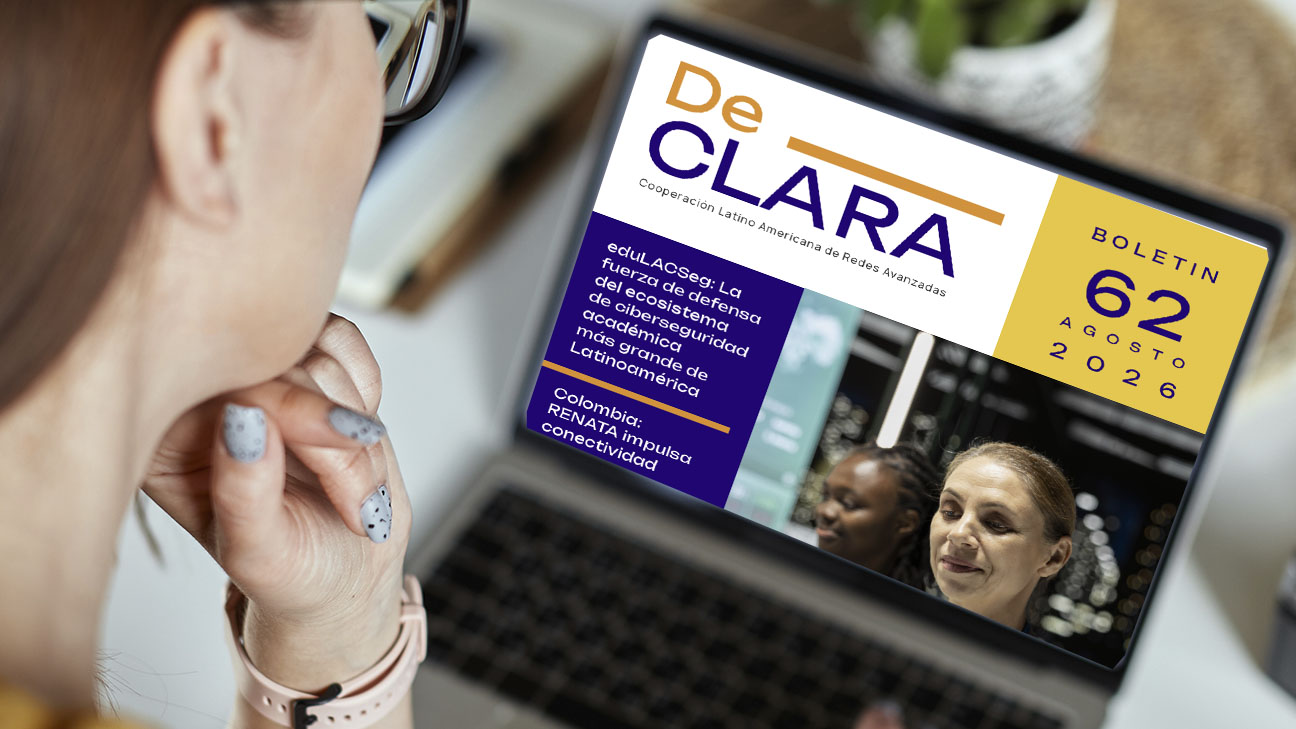
Issue 62 of DeCLARA is now available. This publication brings together some of the most significant initiatives currently being driven by the National Research and Education Networks (NRENs) and RedCLARA in the areas of cooperation, digital transformation, connectivity, cybersecurity and innovation. We invite you to read this new edition and discover the stories, projects and leadership that are strengthening education, science and digital transformation in Latin America and the Caribbean.
The new edition opens with an inspiring editorial by Juan Pablo Carvallo, Executive Director of CEDIA and a member of the RedCLARA Board of Directors, entitled “Cooperating to compete: the strength of Latin American NRNs”. In it, Carvallo offers a profound reflection on the need to transform individual countries’ capabilities into regional capabilities, emphasising that the competitiveness of Latin America and the Caribbean will increasingly depend on the ability to collaborate, share infrastructure, develop digital public goods and build technological sovereignty through the joint efforts of academic networks. The editorial also cites eduLACSeg, RUTE-ALC and SCALAC as concrete examples of how regional cooperation can become a platform for development across the entire region.
One of the main features of this issue is the in-depth report dedicated to eduLACSeg, the Regional Cybersecurity Group of the Latin American and Caribbean National Research and Education Networks (RNIE), which has established itself as the region’s largest ecosystem for collaboration in academic cybersecurity. Through a comprehensive review of its nearly five years of existence, the article shows how collaboration between networks has enabled the creation of a trusted community that shares threat intelligence in real time, promotes specialised training programmes, develops joint tools and strengthens the response capabilities of universities and research centres.
The report also reveals how, thanks to partnerships with organisations such as CERN, GÉANT and LAC4, the region now has advanced mechanisms for exchanging threat intelligence, cybersecurity maturity assessment programmes and a network of specialists working in coordination to tackle challenges that transcend national borders. The experiences shared by experts from Mexico, Chile, Brazil, Colombia, Uruguay, Costa Rica, Ecuador and Europe demonstrate that cooperation is now the main strength of the regional academic cybersecurity ecosystem.
This edition also includes other articles of great interest, amongst them:
- The historic infrastructure roll-out led by RENATA, which enabled communities north of the Magdalena River to be connected via the first sub-aquatic fibre-optic cable laid in Colombia.
- The signing of the Helsinki Declaration, which expands global cooperation to support Earth observation and the international exchange of scientific data.
- The sixth study visit by the CEDIA Rectors’ Community to China, focusing on innovation, artificial intelligence, digital infrastructure and university-industry links.
- REUNA’s accession to the IOWN Global Forum and new international cooperation initiatives driven by CUDI, RNP and other networks within the RedCLARA community.
- The Smart Agro RAF LATAM initiative, which uses blockchain technology to enhance traceability and competitiveness in family farming across Latin America.
DeCLARA 62 invites you to discover how collaboration between networks, institutions and individuals is generating shared capabilities, driving innovation and building solutions to the region’s major challenges.
Download DeCLARA 62 at: https://www.redclara.net/images/BoletinDeCLARA/Boletin_DeCLara_62_EN.pdf
View all editions of DeCLARA at: https://www.redclara.net/en/noticiasyeventos/boletin-declara

Rambla República de México 6125.
Montevideo 11400. Uruguay.
Montevideo 11400. Uruguay.