


Colombia: RENATA drives historic connectivity in communities north of the Magdalena River
María José López Pourailly
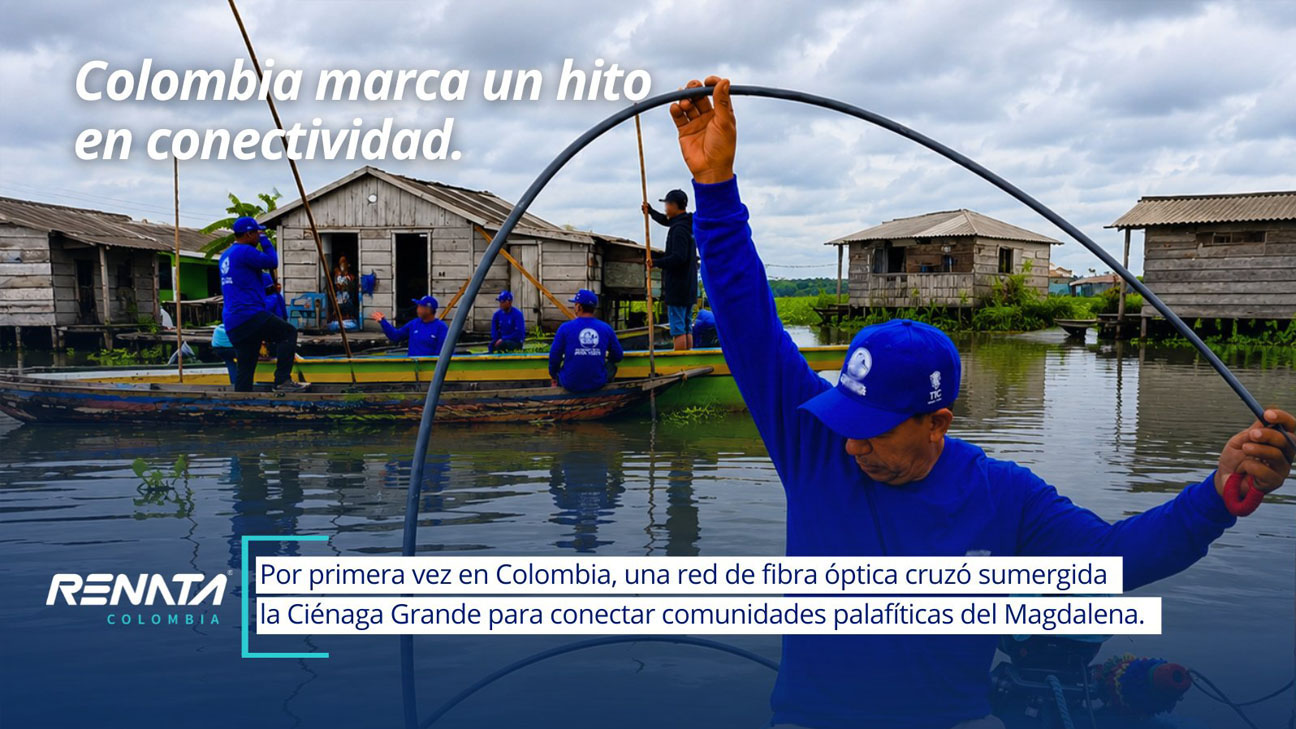
For the first time, an underwater fibre-optic network has crossed the Ciénaga Grande de Santa Marta to connect stilt-house communities and strategic municipalities north of the Magdalena River, in an initiative led by Colombia’s Ministry of Information and Communications Technologies and implemented by RENATA, the country’s National Research and Education Network (NREN) and a member of RedCLARA.
Launched during the first half of June (two years after the signing of the agreement that paved the way for its implementation), the initiative marks a milestone for connectivity in Colombia by deploying fibre-optic infrastructure in particularly complex geographical conditions, with the aim of bringing high-speed internet access to communities built on the water and to areas historically remote from major urban centres.
And when we say ‘particularly complex’, it is important to note that, in order to reach this highly isolated population in such rugged terrain, RENATA had to assess and implement infrastructure never before undertaken in Colombia. This is the first time an underwater fibre-optic cable has been laid in the country; the total length of this network comprises 62 km underwater and 342 km of terrestrial fibre-optic cable. Those 62 km represent a major milestone given their complexity and innovation, which is unprecedented in the country.
The project enabled the municipalities of Ciénaga, Pueblo Viejo, Sitionuevo and Remolino, as well as the stilt-house communities of Buenavista and Nueva Venecia, to be connected via a technological solution combining 62 kilometres of sub-marine fibre-optic cable and 342 kilometres of terrestrial fibre-optic cable.
Thanks to the infrastructure deployed by RENATA, 14,158 households now have internet connectivity: 8,477 in Ciénaga, 3,005 in Pueblo Viejo, 1,952 in Sitionuevo, 90 in Remolino and 634 in the stilt-house villages. Beyond internet access and its obvious benefits, the initiative opens up new possibilities for education, knowledge, digital services, inclusion and local development.
RENATA plays a strategic role in strengthening the country’s digital infrastructure and in coordinating efforts that bring communities closer to the knowledge ecosystem. Its participation in this initiative—which not only focused on technological development but also involved supporting the community through training, fostering ownership and promoting the correct use of ICT—reaffirms the value of advanced academic networks as enablers of social transformation, cooperation and innovation.
For RedCLARA, this development represents a concrete example of how national research and education networks contribute to bridging the digital divide in Latin America, by promoting infrastructure that connects regions, expands opportunities and strengthens equitable access to education, science and technology.

Rambla República de México 6125.
Montevideo 11400. Uruguay.
Montevideo 11400. Uruguay.